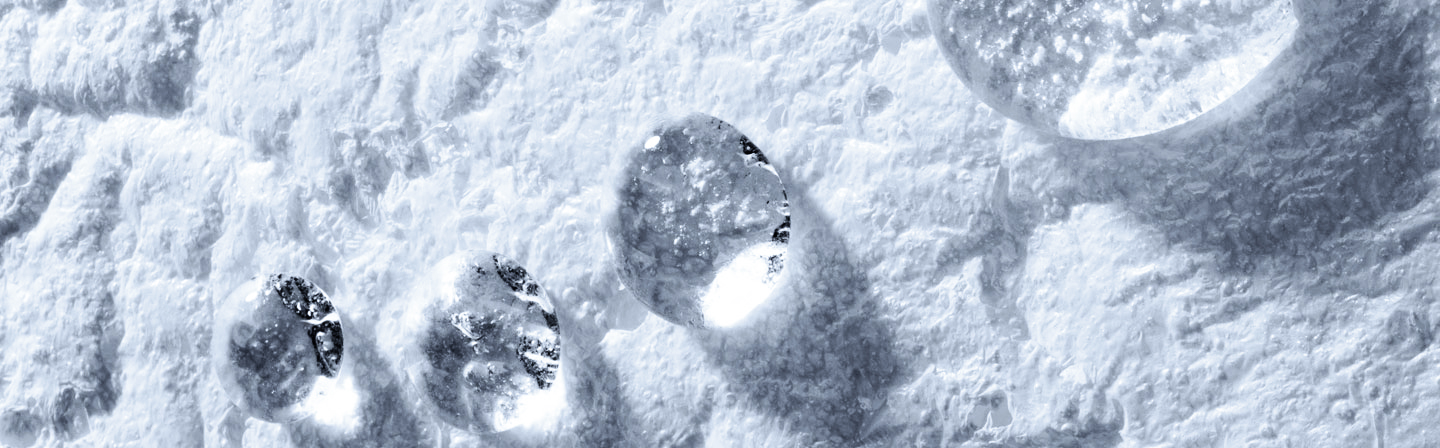
Surface analysis

The wetting, the adhesion to other objects, or the adhesion of paints is determined by the chemical and physical structure of a surface layer which is less than 1 nm thick. An analysis of chemically heterogeneous surface layers in that dimension is very challenging for modern analytical technology.

Chemical functionalities have to be analyzed in a concentration in the order of 10-10 mol/cm2 before a background of the bulk material which is usually at least 104 times higher.

The combination of surface chemistry with instrumental methods creates powerful tools for the determination of functional groups on polymer surfaces. The idea behind this method called labelling or derivatization is that a certain functional group or a class of functional groups is reacted specifically with an agent that can be easily analyzed by an instrumental method. 

Surface functional group analysis by fluorescence labelling (FL)

X-ray photoelectron spectrometry (XPS)

Contact angle goniometry (CAG)

Dynamic vapour sorption (DVS)

Mercury porosimetry

Volumetric gas adsorption

Ellipsometry

Your contact persons

Surface functional group analysis using fluorescence labeling (FL)

Analyt

Surfaces of solids
(including powders and granules)

  • sample size: > 2 mm x 5 mm
  • detection sensitivity:
    0.001 monolayer
  • functional groups: -OH, C=O, COOH, NH, NH2

Equipment

Spex Fluorolog 122

  • Excitation with a xenon lamp
  • single excitation monochromator, double emission monochromator
  • SEV Detector

Result

  • concentration of the functional group

Applications

Determination of
functional group concentrations

  • for immobilizing biomolecules
  • precise characterization of
    surfaces after treatment

Comparative and additional methods

  • X-ray photoelectron spectroscopy (XPS)
  • Contact Angle Measurement (CAG)
  • Secondary Ion Mass Spectrometry (SIMS)

Your contact person

X-ray photoelectron spectroscopy (XPS)

Analyt

Surface of solids, including films, foils, sheets, powders, pellets, fibers, fabrics and coated substrates. Air- and moisture-sensitive samples can be handled and transferred under inert conditions. Vacuum-compatible ionic and low-volatility materials can also be investigated.


  • min. sample size: > 0.3 mm × 0.7 mm
  • max. sample size: 30 mm × 60 mm × 19 mm
  • typical XPS information depth: up to ~10 nm, depending on material and emission angle
  • typical detection limit: approx. 0.02–0.5 at.%, depending on element and matrix

Equipment

Kratos Axis Supra+

  • X-ray sources: monochromatic Al anode, Al/Mg dual-anode tube
  • sampling area: normal 300 µm × 700 µm; microspot: 120 µm, 60 µm, 30 µm
  • chemical-state imaging, maximum lateral resolution approx. 2 µm
  • variable take-off angle
  • depth profiling with monatomic argon ions for inorganic materials and gas-cluster ion sputtering for damage-reduced profiling of organic and polymeric materials
  • UV photoelectron spectroscopy (UPS) for valence electronic structure, work function and ionization-energy measurements
  • glovebox-coupled sample handling and inert transfer for air- and moisture-sensitive materials

Results

  • elemental surface composition
  • chemical states, oxidation states, bonding environments and functional groups
  • lateral chemical-state distribution by XPS imaging
  • depth-dependent chemical composition and chemical-state information
  • valence electronic structure, work function and ionization energy by UPS
  • combined chemical and electronic characterization of surfaces and interfaces by XPS and UPS

Comparative and
complementary methods

  • Fluorescence labelling (FL)
  • Contact angle goniometry (CAG)
  • Secondary ion mass spectrometry (SIMS)
  • Atmospheric photoelectron spectroscopy (AC-2) for work-function and ionization-potential measurements of surfaces and thin films

Applications

  • quality control of cleaning, activation, functionalization and coatings on surfaces
  • failure and interface analysis in adhesive joining, printing and coating processes
  • chemical analysis of coatings, adsorbate layers and surface contamination
  • determination of functional groups on polymer surfaces
  • ex situ XPS and depth-profile analysis of air-sensitive battery electrodes and solid electrolyte interphases (SEI) using inert sample transfer
  • XPS and UPS characterization of thin films and interfaces for organic electronics and OLED materials
  • surface-state analysis of metallic joining materials, including oxide/hydroxide layers, contamination and ageing, with correlation to welding performance
  • chemical-state characterization of vacuum-compatible ionic liquids and low-melting organic–inorganic materials
  • surface and interface analysis of catalysts, functional carbon materials, hybrid materials and other complex material systems

Publications

Adesina et al., “Visible light degradation of tetracycline and bisphenol A by a hybrid photocatalyst composed of orange peel biochar, clay, and C/N-doped titania,” New Journal of Chemistry (2026). DOI: 10.1039/D6NJ00633G.

Horner, T. et al. “Unravelling the Secret of Sulfur Confinement and High Sulfur Utilization in Hybrid Sulfur-Carbons.” Advanced Materials 38 (2026), e13346. DOI: 10.1002/adma.202513346.

Eren, E. O. et al. “CVD-grown tunable carbon films for high-performance sodium storage.” Energy & Environmental Science 19 (2026), 4603–4615. DOI: 10.1039/D6EE01852A.

Moon, S. et al. “Laser-carbonized anodes for sodium-ion batteries: A sustainable fabrication route toward spatially resolved and practical energy storage.” Energy Storage Materials 84 (2026), 104793. DOI: 10.1016/j.ensm.2025.104793.

Ozherelkov, D. et al. “Effect of storage parameters and surface state on the ultrasonic welding behavior and mechanical properties of aluminum stranded wires.” Welding in the World 70 (2026), 1035–1049. DOI: 10.1007/s40194-025-02196-y.

Block et al., “Improving Spent Coffee Biochar for Effective Organic Contaminant Removal from Aqueous Media,” ACS Omega (2025). DOI: 10.1021/acsomega.4c09171.

Adesina et al., “Orange peel biochar/clay/titania composites: low cost, high performance, and easy-to-reuse photocatalysts for the degradation of tetracycline in water,” Environmental Science: Water Research & Technology 10 (2024), 1432–1450. 1432–1450. DOI: 10.1039/D4EW00037D.

Balischewski, C. et al. “Elucidating the Iron-Based Ionic Liquid [C4py][FeCl4]: Structural Insights and Potential for Nonaqueous Redox Flow Batteries.” Advanced Functional Materials 34 (2024), 2311571. DOI: 10.1002/adfm.202311571.

Contact angle measurement (CAG)

Analyt

Surfaces of flat solids

  • Sample size: > 20 mm x 20 mm
  • Test liquids: water, formamide,
    glycerin, tricresyl phosphate,
    methylene iodide; others available upon request

Equipment

  • Krüss DSA100 Automatic Video Goniometer

Evaluation methods and results

  • surface energy
  • Lewis acid/base properties
  • Owens / Wendt-, van Oss-Models


Applications

  • determination of the
    wetting properties of solids
  • characterization of the treatment
    effect / quality control in
    surface activation, functionalization, and coating


Comparative and
complementary methods

  • X-ray Photoelectron Spectroscopy (XPS)
  • Fluorescent Labeling (FL)
  • Secondary Ion Mass Spectrometry (SIMS)

Your contact person

Dynamic water vapor sorption (DVS)

Analyt

  • samples capable of absorbing water vapor and organic
    solvents
  • phase transitions in polymers
  • 10–30 mg of sample material


Equipment

Water vapor sorption device consisting of:

  • DVS Resolution (Dual Vapor Gravimetric Sorption Analysis)
  • temperature-controlled sample chamber (temperature range: 5–85 °C)
  • Cahn balance (Ultramicrobalance)
  • image capture via connection
    to a video camera


Evaluation methods and results

  • determination of water vapor absorption at variable relative humidity (0–98 %) and constant temperature (equilibrium moisture content)
  • determination of adsorption and desorption isotherms
  • kinetic measurements of sorption and desorption at specified relative humidity and temperature
  • use of other solvents as well as
    mixtures
  • Calculation of the specific surface area using appropriate analysis software

Applications

  • determination of Water Vapor Sorption in Bead-Shaped Cellulose
  • determination of sorption data for
    foamed chitosan
  • determination of the sorption kinetics of wood chips
  • sorption and desorption behavior
    of wood, plant, and paper fibers

Your contact person

Mercury porosimetry

Analyt

  • solid samples with and without pores /
    voids
  • samples must be inserted while dry
  • 0.5–1 g of sample material
    (depending on porosity)


Equipment

Mercury porosimeter consisting of:

  • Pascal 140 mit einem Druckbereich von 0,013 − 0,4 MPa zur Bestimmung der Makroporen 
  • Pascal 440 with a pressure range
    of 0.1–400 MPa for determining
    mesopores (Thermo Electron
    Corporation, Milan, Italy)


Evaluation methods and results

  • determination of pore volume
    in the measurement range
  • determination of pore diameters and distribution (pore detection between 4 nm and 116,000 nm in diameter)
  • determination of porosity and
    density calculations
  • calculation of the specific surface area based on various pore models
  • determination of particle sizes ranging from 0.01 to 330 µm

Applications

  • determination of the cumulative pore volume, the average pore diameter, and their distribution in porous cellulose beads
  • determination of specified target values in foamed chitosan products
  • determination of specified target values in building materials (e.g., concrete)

Your contact person

Volumetric gas adsorption

Analyt

  • solid samples with and without pores / voids
  • samples must be inserted while dry
  • 0.5–3 g of sample material 
    (depending on porosity)


Equipment

Nitrogen sorption apparatus, consisting of:

  • sorptomatic 1990 (Thermo Electron Corporation, Milan, Italy)
  • physisorption: N2, Kr, He
  • vacuum furnaces for sample pretreatment

Evaluation methods and results

  • determination of the specific surface area
    (> 0.2 m²/g with N₂, > 0.005 m²/g with Kr)
  • calculation of pore diameters and distribution using various modeling methods (ADP software)
  • pore detection between 0.4 nm and 100 nm in diameter
  • pore volume calculation > 0.001 cm³/g

Applications

  • determination of specific surface area and calculation of pore diameter
    and pore size distribution in aerocellulose
  • determination of the aforementioned parameters in
    foamed chitosans
  • determination of the aforementioned parameters in
    cellulosic nanoparticles

Your contact person

Ellipsometry

Analyt

  • thin organic or inorganic layers
  • thickness range: a few tenths of a nm to several hundred nm

Equipment

  • Optrel Multiskop

Results

  • Product of the refractive index and
    layer thickness
    • given a known refractive index
      determination of the layer thickness and
      vice versa

Applications

  • thickness measurement of thin and ultrathin polymer layers
  • step-by-step tracking of the assembly of a multilayer system

Comparative and
complementary methods

  • Surface plasmon resonance (SPR)
  • Profilometry
  • Atomic force microscopy (AFM)

Your contact person

Your contact persons

Manuel Gensler

Contact Press / Media

Dr. Manuel Gensler

Surface Functional Group Analysis (FL) | X-ray Photoelectron Spectroscopy (XPS) | Contact Angle Measurement (CAG)

Fraunhofer IAP
Geiselbergstraße 69
14476 Potsdam

Phone +49 331 568-1913

Jiyong   Kim

Contact Press / Media

Dr. Jiyong Kim

X-ray Photoelectron Spectroscopy (XPS)

Fraunhofer IAP
Geiselbergstraße 69
14476 Potsdam

Phone +49 331 568-1925

Kay Hettrich

Contact Press / Media

Dr. Kay Hettrich

Dynamic Water Vapor Sorption (DVS) | Mercury Porosimetry | Volumetric Gas Adsorption

Fraunhofer IAP
Geiselbergstraße 69
14476 Potsdam

Phone +49 331 568-1514

Daniel Pinkal

Contact Press / Media

Daniel Pinkal

Ellipsometry

Fraunhofer IAP
Geiselbergstraße 69
14476 Potsdam

Phone +49 331 568-1916